
Gluten-free bread with rice flour and easy natural yeast
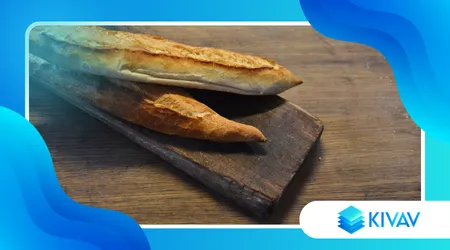
Gluten-free bread with rice flour It's no longer a compromise accepted with resignation. In recent years, it has slowly but surely become a conscious choice even for those without medical obligations.
Announcements
There's something interesting about this evolution: what begins as a medical necessity ends up redefining everyday taste. Gluten-free bread, when made well, stops being "alternative" and simply becomes bread.
This guide starts from here. Not with perfect formulas, but with a concrete balance of technique, experience, and small adjustments that really make a difference.
Summary:
- What gluten-free rice flour bread really is
- Why sourdough changes everything
- Ingredients and rationale behind the choice
- Practical procedure with complete recipe
- Real nutritional values
- Common Mistakes (and Why They Happen)
- FAQ
What is gluten-free rice flour bread?
Talking about gluten-free bread means, first of all, accepting an absence. Gluten is missing, yes, but above all, it lacks the elastic structure that has defined European bread for centuries.
Announcements
Rice flour comes into its own here. It's subtle, almost neutral, and that's exactly why it works. It doesn't impose a dominant flavor, but rather provides a foundation upon which to work.
Don't expect a copy of traditional bread. The result is different, sometimes moister, less airy. Yet, when the balance is right, it becomes surprisingly satisfying.
Why choose natural yeast for gluten-free products?
Natural yeast introduces time, and time changes everything. In a gluten-free dough, where the structure is fragile, slow fermentation becomes an invisible form of construction.
There's also a less obvious, often misunderstood aspect: flavor. Sourdough starter develops complex notes that offset the simplicity of rice flour, avoiding the flat taste typical of many industrial products.
According to the updated indications of the’European Food Safety Authority, prolonged fermentation processes can improve the overall digestibility of baked goods.
Which ingredients really make a difference?
Reducing everything to a list of ingredients would be misleading. What matters here is the ratio of ingredients, rather than their mere presence.
Rice flour, water, gluten-free sourdough starter, salt. Then comes the critical point: the binding agent. Psyllium or xanthan gum aren't optional; they're what holds the dough together when gluten isn't present.
++ Focaccia stuffed with escarole, olives and capers, a Mediterranean flavour
This step is often overlooked. The result? Bread that crumbles when first cut, or, conversely, is too compact. This isn't a rare mistake; it's almost inevitable at first.
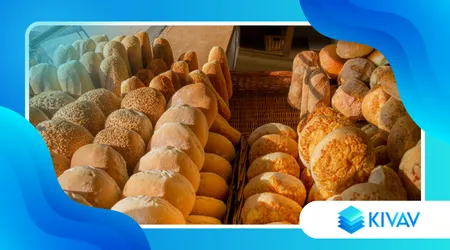
How to Make Bread Step by Step (Practical Recipe)
Here, things get concrete. No superfluous theory, just clear, repeatable steps.
Ingredients:
- 300 g rice flour
- 320 ml warm water
- 100 g active gluten-free sourdough starter
- 8 g salt
- 10 g psyllium powder
- 40 ml water (to hydrate the psyllium)
Start by hydrating the psyllium with the 40 ml of water. After a few minutes, it will become gelatinous, which is exactly what you need.
In a large bowl, combine rice flour and warm water. Mix slowly: there's no need to knead, just ensure a uniform consistency.
Interesting: Focaccia from Bari with cherry tomatoes and oregano: a top Apulian recipe
Add the sourdough starter and mix well. Only then add the hydrated psyllium and, finally, the salt.
The dough will look different from traditional dough, more like a dense mass than an elastic dough. This is normal.
Let it rest for about two hours at room temperature. Don't expect it to double dramatically, but a slight rise is a good sign.
Transfer to the mold, level with a damp spatula and leave to rise for another hour.
Bake at 220°C for 40 minutes. For the first 10 minutes, create steam in the oven: a small trick that noticeably changes the crust.
Let it cool completely before cutting. Cutting it too early is one of the most common mistakes, and it ruins everything.
What are the nutritional values of rice flour?
Rice flour is often perceived as "light," but this is an oversimplification. It's actually a significant energy source, with a distinct nutritional profile.
| Component (100g) | Average value |
|---|---|
| Calories | 366 kcal |
| Carbohydrates | 80 g |
| Proteins | 6 g |
| Fats | 1 g |
| Fibers | 2.4 g |
Source: USDA FoodData Central (updated 2025)
It doesn't excel in fiber or protein, which is precisely why many bakers combine it with other gluten-free flours. It works on its own, but it has obvious limitations.
++ Lombard Country Cake: A Dessert of Recovery and Memory
Why does gluten-free bread often disappoint?
There's a widespread belief that following the recipe is enough. In reality, gluten-free bread is less forgiving of mistakes than traditional bread.
Hydration, for example, isn't a minor detail. A minimal change can turn the dough into something unmanageable or, worse, a heavy, soggy loaf.
Sourdough starter also plays a delicate role. If it's not active, the result won't simply be "less good," but completely unbalanced.
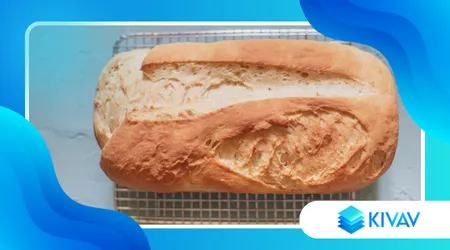
When to consume it and how to store it?
Fresh out of the oven, gluten-free bread seems very promising. But it takes a few hours for it to really firm up, when the crumb reaches the ideal consistency.
The best time to enjoy it is the same day. Afterward, it tends to lose moisture more quickly than traditional bread.
Freezing it in slices is a practical solution. Refrigeration, however, accelerates the hardening process and is rarely a good idea.
Conclusion
Making gluten-free bread requires a shift in perspective rather than a simple technical adaptation. It's not about imitating, but understanding how different ingredients work together.
Rice flour, combined with natural yeast, offers a solid foundation for building something authentic. Not perfect, perhaps, but real, and surprisingly satisfying.
To learn more about celiac disease and nutrition gluten-free.
FAQ – Frequently Asked Questions
Does gluten-free bread rise less?
Yes, but that's not necessarily a flaw. The structure is different and must be interpreted differently than traditional bread.
Can psyllium be avoided?
Technically yes, but the result will be much more fragile. Psyllium plays a structural role that's difficult to replace.
Does gluten-free sourdough change the flavor?
Clearly. It adds acidity and complexity, making the bread more interesting than versions made with industrial yeast.
Is it suitable for a daily diet?
Yes, if included in a balanced diet. It's still a significant source of carbohydrates, so it should be managed carefully.
++ Gluten-Free Rice and Corn Flour Bread with Walnuts
