
Murgia black chickpea salad with red onion and bay leaves

Prepare a’Murgia Black Chickpea Salad It is not a simple exercise in Apulian cuisine, but an act of gastronomic resistance.
Announcements
This legume, which seems to whisper stories of drought and stony fields, defies modernity with a tough skin and a heart that never completely gives in to softness.
Summary
- The identity of the black chickpea among rocks and dust
- Because its fiber is different from any other legume
- Color contrast: not just aesthetics
- Slow times for real digestibility
- The Recipe: Bay leaves, onion and patience
- Nutritional values compared
- Leftover management and flavor maturation
The enigma of the black chickpea among the karst rocks
The Murgia black chickpea is not the poor cousin of the classic sand-colored chickpea; if anything, it is its wilder and prouder ancestor.
Grown on lands where water is a premium and stone dominates the landscape, this seed has developed a resilience that is reflected in its structure.
The wrinkled shape, almost similar to a dark coffee bean, hides a ferrous core that evokes the flavor of beaten earth and undergrowth.
Announcements
People often mistake it for just another legume, but its geographical origins, nestled between Cassano and Acquaviva, require an almost ceremonial approach.
It's not a product for those in a hurry. Its inclusion in the Slow Food Presidia isn't a tourist attraction, but rather recognition of a biodiversity that risked extinction because it was "too difficult" to harvest and cook.
Beyond Color: An Atypical Nutritional Structure
There's something almost medicinal about this ingredient. While light-colored legumes offer a reassuring softness, Murgiano chickpeas boast a concentration of anthocyanins and fiber that triples the common standards.
This density is not just a technical fact, but translates into a significantly lower glycemic index and satiety that lasts for hours.
Iron, present in massive quantities, makes it the cornerstone of those who have chosen to eliminate animal proteins without sacrificing physical strength.
It's often overlooked that its peel, so criticized by those who prefer pureed soups, is actually a treasure chest protecting B vitamins and minerals that the karst soil has filtered for millennia. Eating it means absorbing the power of Apulian stone.
++ Artichoke and Pecorino Romano tart: a fragrant side dish with a Lazio heart.
Legume Identikit: Data and Real Times
| Parameter | Description | Value per 100g |
| Soaking | Essential for rehydration | 36 – 48 hours |
| Cooking | Very low, constant flame | 2.5 – 3 hours |
| Iron | Essential contribution | 6.8 mg |
| Fibers | Support for intestinal flora | 15 g |
| Proteins | High biological value | 22 g |
The Recipe: Murgia Black Chickpea Salad with Onion and Bay Leaves
The beauty of this dish lies in the balance between the sharpness of the legume and the pungent sweetness of the other ingredients. This isn't a salad to be put together at the last minute; it requires a vision that begins two days in advance.
Ingredients:
- 300g dried black chickpeas
- 2 fresh bay leaves (dry bay leaves lose the necessary balsamic note)
- 1 red onion (preferably from Acquaviva or Tropea)
- Coratina monocultivar extra virgin olive oil
- White wine vinegar or lemon juice
- Whole sea salt and black peppercorns
Interesting: Ligurian-style stuffed onions with bread, olives, and marjoram
Procedure:
The ritual begins with soaking: 48 hours is the ideal time, changing the water every 12. Don't skip this step thinking that 12 hours is enough; black chickpeas are stubborn.
After rinsing, place them in a terracotta pot with plenty of cold water and the bay leaves.
Bay leaves are not only used for their aroma, but also contain essential oils that make chickpea fiber much more tolerable for the intestines.
Cook over very low heat. The skin should not break. Once tender, drain and let them breathe. Meanwhile, slice the red onion very thinly and let it soak in cold water and a tablespoon of vinegar for twenty minutes: this step takes the toughness out of the bulb, making it digestible and crunchy.
Find out more: Stracchino: the fresh Lombard cheese perfect for focaccia
In a large bowl, combine the still-warm legumes with the drained onion. Drizzle generously with Coratina olive oil: its artichoke aroma and spicy finish are the perfect complement to the chickpea's mineral flavor. A sprinkle of freshly ground pepper completes the dish.
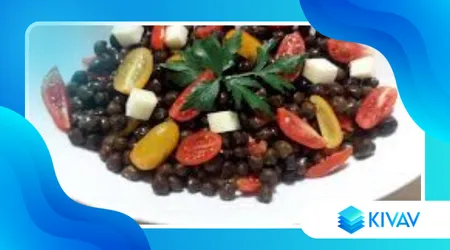
Murgia Black Chickpea Salad
Why is laurel the silent ally?
The use of bay leaves in this recipe isn't just an aesthetic quirk. In Puglia, adding fresh leaves to the cooking water is a traditional wisdom for handling legumes with thick skins.
The chemical interaction between the tannins of the chickpea and the aromas of the bay leaves creates a cooking broth that is, in itself, an elixir.
Some prefer to add sun-dried tomatoes or a pinch of chili pepper, but the purist version with only red onion allows you to appreciate the layering of flavors.
You can learn more about the botanical varieties typical of the area on the portal of Ministry of Agriculture, where the protection of biodiversity is analyzed with scientific rigor.
The modern interpretation of an archaic dish
Today, this salad appears in gourmet settings, often paired with red prawns or grilled cuttlefish. The contrast between the stark black of the legume and the pure white of the mollusks is visually captivating.
However, its most honest form remains the solitary one, eaten with a piece of toasted Altamura bread.
It's a dish that challenges the perception of "comfort food": it's not creamy, it's not comforting, but it is deeply satisfying.
The prolonged chewing it requires forces us to slow down, transforming the meal into a moment of food awareness that we rarely find in industrial products.
For those who wish to further explore the network of producers who still cultivate these varieties today, challenging the logic of the global market, the website of Slow Food Italy offers a detailed mapping of the Apulian garrisons.
FAQ – Common questions about preparation
Why are my black chickpeas still hard after 3 hours?
The soaking was probably too short, or the cooking water contained too much limescale. Always use mineral water if you live in a hard water area, and never add salt before the end of cooking, as it hardens the outer membrane.
Can I replace the red onion with the yellow onion?
Not recommended. The red onion adds a sweet note that balances the almost metallic flavor of the black chickpeas. If you're worried about raw onion, marinating it in vinegar will solve any heaviness.
Can this salad be served hot?
Absolutely. While it's best served at room temperature, a warm version with the addition of a sprig of fresh rosemary is excellent on autumn days, retaining its rustic elegance.
How long does it last in the refrigerator?
THE'Murgia Black Chickpea Salad It gets better the next day. It keeps well for up to 72 hours; the important thing is to add a drizzle of raw olive oil just before serving to enhance the aromas of the bay leaves and onion.
++ Black chickpea, celery, tomato and onion salad with herb oil
